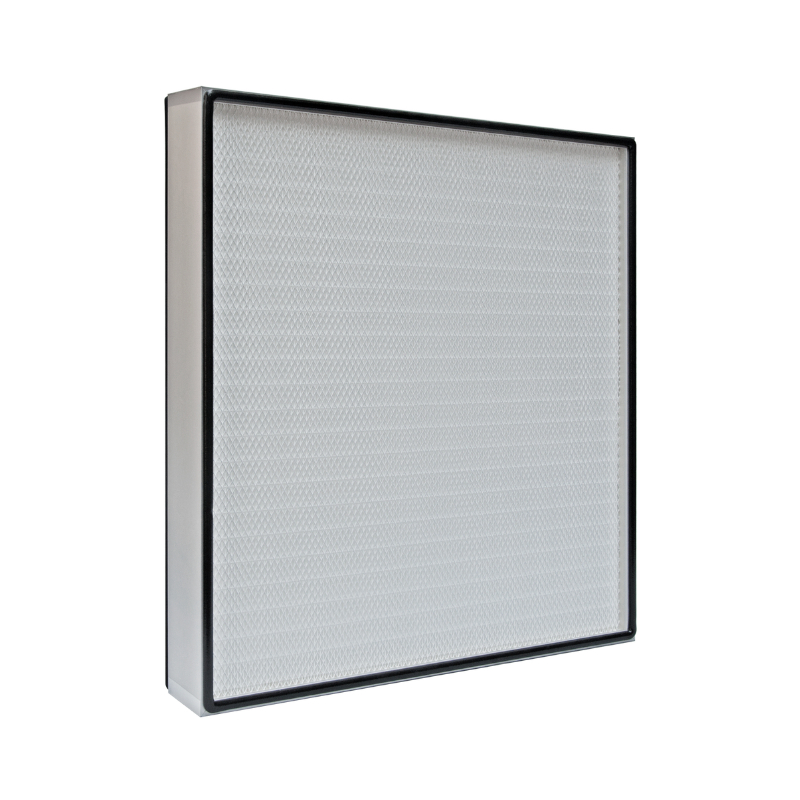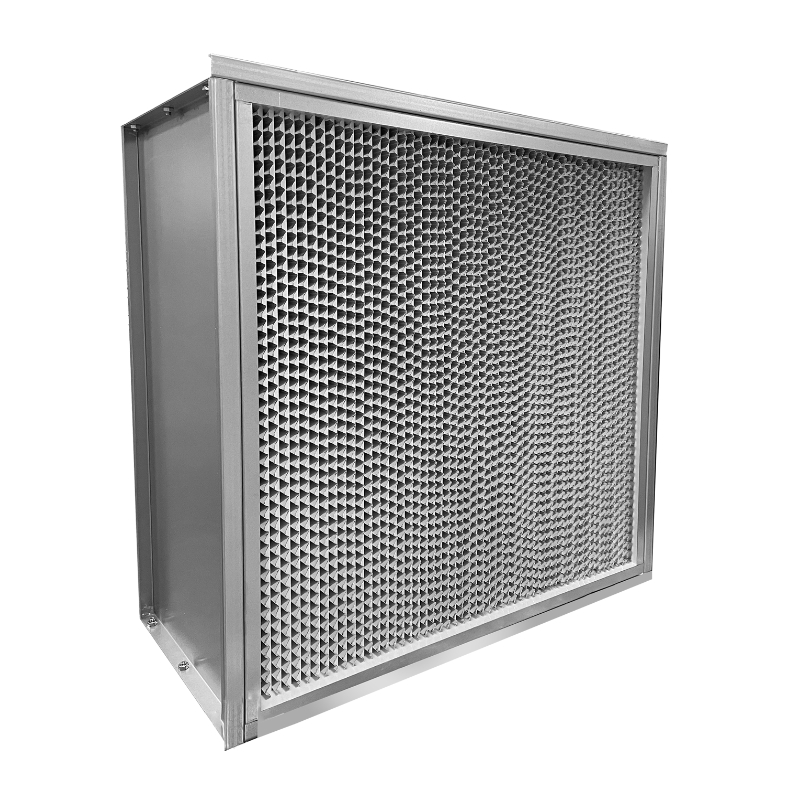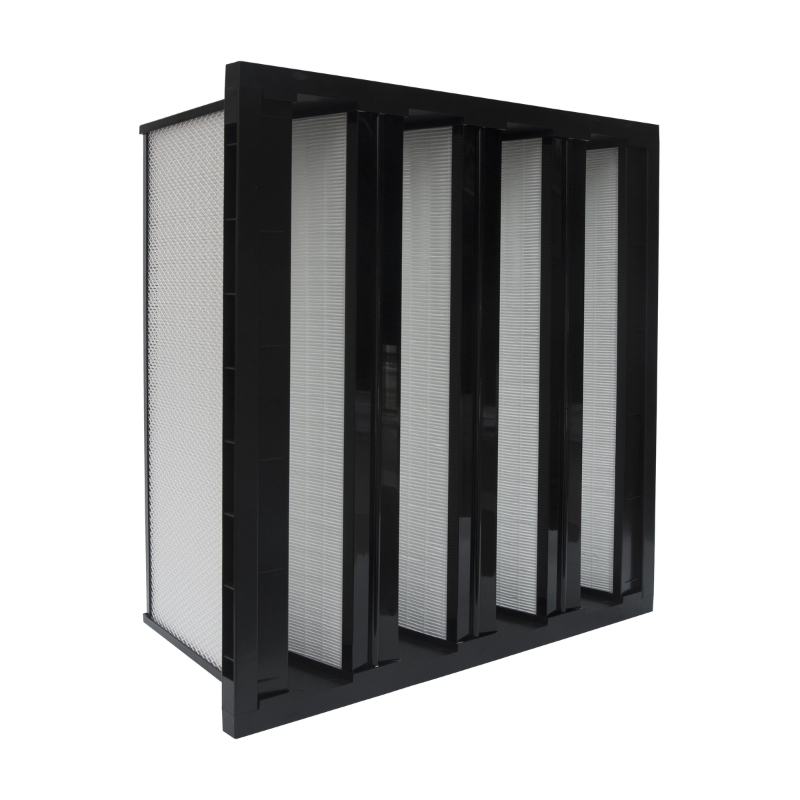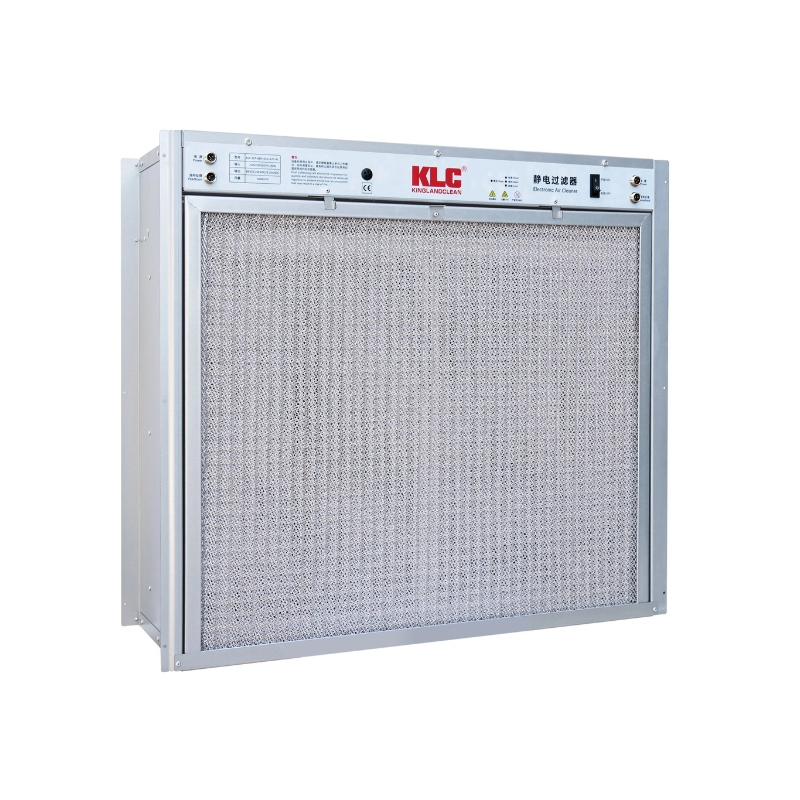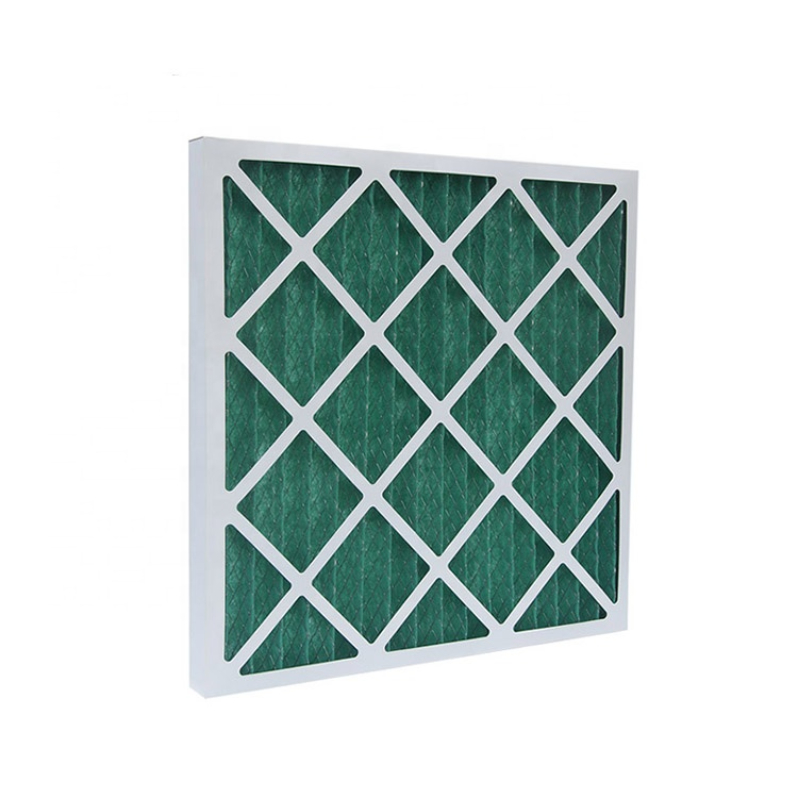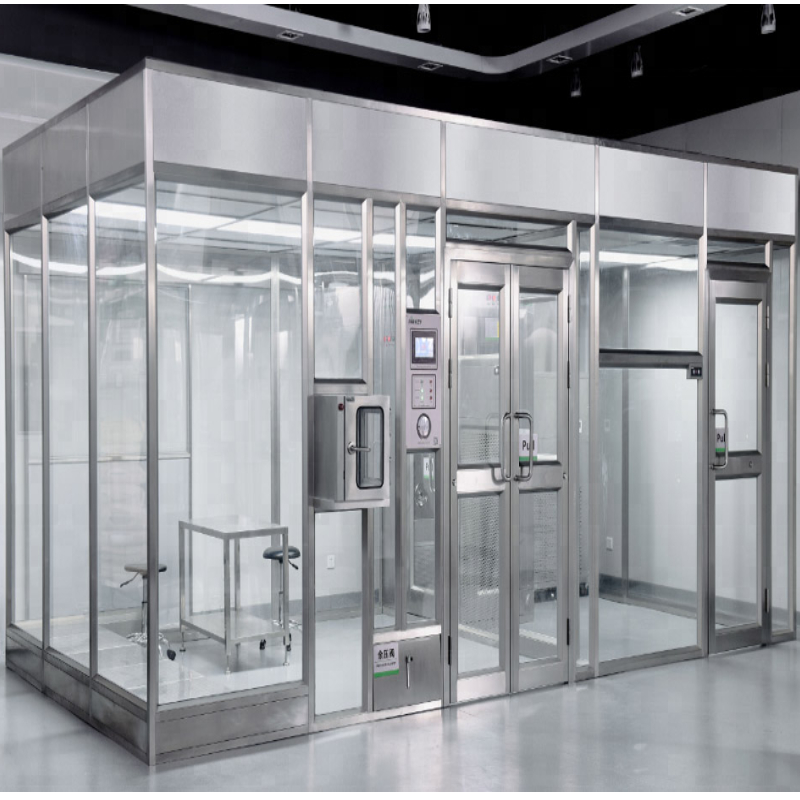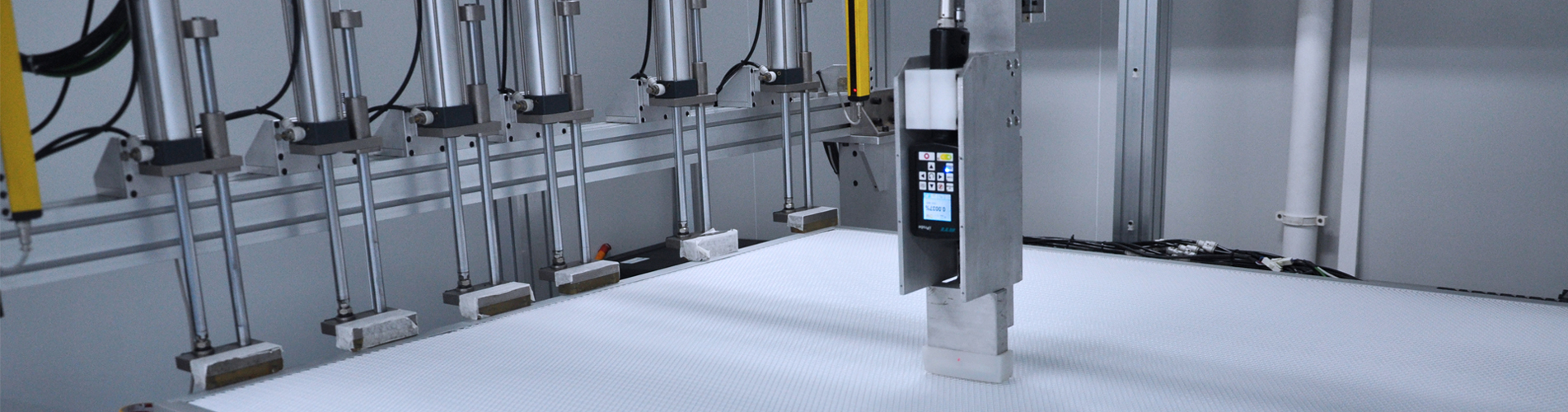
Filtre HEPA La validation est effectuée par des tests d'intégrité in situ utilisant des méthodes d'aérosol PAO ou DOP basées sur un photomètre, en balayant en aval à ≤5 cm/s pour garantir que la pénétration locale ne dépasse pas 0,01 % du défi en amont, conformément aux protocoles EN 1822 et ISO 14644-3.
Cet article technique présente en détail les procédures, normes et équipements nécessaires à la validation des filtres HEPA (filtres à air à haute efficacité pour les particules) en salles blanches. Il aborde la transition des aérosols DOP aux aérosols PAO, fait référence aux cadres réglementaires EN 1822 et ISO 14644-3, décrit la méthodologie de contrôle et définit les seuils de fuite. Ce guide s'adresse aux ingénieurs de maintenance CVC, aux entreprises de validation de salles blanches et aux auditeurs qualité pharmaceutiques qui exigent des procédures de test précises pour le maintien de la certification des salles blanches.
Les tests d'intégrité in situ des filtres HEPA, souvent appelés tests d'étanchéité, consistent à introduire une concentration contrôlée de gouttelettes de liquide en suspension dans l'air en amont du filtre. Ces gouttelettes constituent une contrainte physique permettant de tester l'étanchéité du média filtrant, des joints entre le cadre et le média, ainsi que des joints du boîtier du filtre. Historiquement, deux composés ont dominé ce domaine : le phtalate de dioctyle (DOP) et la polyalphaoléfine (PAO).
Pendant des décennies, le phtalate de dioctyle (DOP) a constitué la référence mondiale en matière d'aérosols. Chimiquement, il s'agit d'un ester de l'acide phtalique. Lorsqu'il est pulvérisé à l'aide de générateurs thermiques ou pneumatiques, il produit un aérosol monodispersé ou polydispersé dont la granulométrie est homogène autour de 0,3 micron. Cependant, des études toxicologiques ont finalement classé le DOP comme cancérogène suspecté pour l'homme et perturbateur endocrinien. Il a été constaté qu'une exposition professionnelle répétée présentait des risques pour la reproduction des techniciens, et le rejet de ce produit chimique dans l'environnement a été réglementé par des organismes tels que l'OSHA et l'EPA.
Pour répondre à ces préoccupations sanitaires et environnementales, l'industrie des salles blanches s'est tournée vers la polyalphaoléfine (PAO). La PAO est un oligomère synthétique hydrogéné de 1-décène. Non toxique, non cancérogène et très stable, elle reproduit fidèlement les caractéristiques physiques du DOP lorsqu'elle est pulvérisée, générant un aérosol polydispersé dont le diamètre aérodynamique médian en masse (DAMM) est compris entre 0,25 et 0,35 micron. Grâce à son comportement physique identique dans les milieux de filtration, sans risque chimique pour la santé, la PAO a quasiment supplanté le DOP dans la validation des salles blanches modernes.
Deux normes principales régissent les essais et la classification des filtres à haute efficacité :
EN 1822 (Parties 1 à 5) :Cette norme européenne classe les filtres en fonction de leur efficacité à la taille de particules la plus pénétrante (MPPS). Selon la norme EN 1822, les filtres sont catégorisés de EPA (E10-E12) à HEPA (H13-H14) et ULPA (U15-U17). Par exemple, un filtre H14 doit présenter une efficacité globale ≥ 99,995 % et une efficacité locale ≥ 99,975 % à sa MPPS. Il s'agit d'un test de classification réalisé en usine à l'aide de compteurs de particules spécialisés.
ISO 14644-3 (Section B.6) :Cette norme régit les essais d'étanchéité in situ (sur site) des filtres installés. Point essentiel, l'ISO 14644-3 ne mesure pas l'efficacité absolue ; elle vérifie plutôt que le système de filtration a été installé sans fuite ni dommage. Le test d'intégrité in situ est un contrôle en aval conçu pour localiser les fuites ponctuelles dans le média filtrant, le cadre ou le joint.
|
Paramètre technique |
DOP (phtalate de dioctyle) |
PAO (Polyalphaoléfine) |
|
Formule chimique / Nature |
(Ester de phtalate). |
Hydrocarbure synthétique (oligomère du 1-décène). |
|
Profil de toxicité et de sécurité |
Cancérigène suspecté chez l'homme ; perturbateur endocrinien ; risque professionnel. |
Non toxique, non dangereux, sans danger pour le contact cutané et l'inhalation aux niveaux testés. |
|
Taille des particules d'aérosol (MMAD) |
~0,3 microns (polydispersé/monodispersé). |
0,25 à 0,35 microns (polydisperses). |
|
Statut EPA/OSHA |
Fortement réglementé ; interdit dans la plupart des établissements alimentaires et pharmaceutiques. |
Approuvé et recommandé pour la validation des salles blanches à l'échelle mondiale. |
|
Compatibilité avec les générateurs d'aérosol |
Générateurs thermiques et pneumatiques. |
Générateurs thermiques et pneumatiques (entièrement interchangeables avec DOP). |
|
Acceptation réglementaire |
Abandonné progressivement dans les pays occidentaux ; encore utilisé dans les spécifications anciennes. |
Norme FDA, EU GMP, ISO 14644-3 et EN 1822. |
|
Coût d'approvisionnement |
Modéré (devient plus cher en raison des limites d'approvisionnement). |
Modéré à élevé (compensé par la réduction des coûts de mise en conformité en matière de sécurité). |
La réalisation d'un test d'étanchéité valide pour un filtre HEPA in situ nécessite un protocole précis et séquentiel afin de garantir l'exactitude et la répétabilité.
Un générateur d'aérosol est rempli de PAO liquide (par exemple, Emery 3004). Ce générateur utilise une buse pneumatique (aérosol froid) ou un élément chauffant (aérosol thermique) pour vaporiser le liquide, créant ainsi un nuage dense de gouttelettes d'huile microscopiques. Cet aérosol est injecté dans le conduit d'air en amont du filtre HEPA. Il est essentiel de choisir un point d'injection suffisamment en amont pour permettre un mélange complet et homogène de l'aérosol sur toute la surface d'entrée du filtre.
Avant de procéder à l'analyse en aval, la concentration de l'aérosol de test en amont du filtre doit être vérifiée à l'aide d'un photomètre d'aérosol étalonné.
•La concentration cible en amont doit se situer entre 10 et 100 microgrammes par litre (µg/L) d'air. Une concentration de 20 à 50 µg/L est idéale pour maintenir la sensibilité du capteur sans saturer le filtre.
•Une fois la concentration stabilisée, le photomètre est réglé pour afficher cette concentration en amont comme valeur de référence (100 %). Toute mesure ultérieure en aval est exprimée en pourcentage direct de cette valeur de référence en amont.
Une fois la valeur de référence à 100 % établie, le technicien de validation connecte une sonde de balayage au photomètre. Cette sonde est dotée d'une entrée rectangulaire (généralement de 10 mm x 30 mm ou 20 mm x 40 mm) conçue pour capter un flux d'air localisé.
•Technique de balayage : La sonde doit être maintenue à environ 20 à 30 mm de la face aval du média filtrant.
•Vitesse de balayage : La sonde doit être déplacée sur la surface du filtre à une vitesse maximale de 5 cm par seconde (50 mm/s). Un déplacement trop rapide empêche le photomètre d’aspirer un échantillon d’air suffisant pour enregistrer un pic localisé, ce qui peut entraîner la non-détection de fuites.
•Motif de balayage : Le balayage doit couvrir toute la surface du filtre par mouvements superposés, en insistant particulièrement sur la jonction entre le média filtrant et le cadre extérieur en aluminium.
Outre le média filtrant, l'inspection doit s'étendre sur le périmètre extérieur du cadre du filtre, y compris à l'interface entre ce dernier et la grille de montage (joint d'étanchéité ou joint en gel liquide). Cette zone présente un risque élevé de fuites par contournement dues à une étanchéité défectueuse ou à un couple de serrage incorrect.
Le critère d'acceptation internationalement reconnu pour la validation in situ des filtres HEPA est le suivant :
•Aucune pénétration locale dépassant 0,01 % (0,0001) de la concentration de test en amont.
•Si le photomètre affiche une valeur supérieure à 0,01 % en un point quelconque, le technicien doit interrompre la mesure, maintenir la sonde à cet endroit précis et attendre que la valeur se stabilise. Si la fuite stabilisée dépasse 0,01 %, elle est considérée comme une défaillance.
•Conformément aux normes des salles blanches (par exemple, ISO 14644-3), les fuites mineures de fluide filtrant peuvent être réparées à l'aide d'un mastic silicone de qualité pharmaceutique. Toutefois, la surface totale réparée ne doit pas excéder 0,5 % de la surface du filtre, et aucune réparation ne doit dépasser 3,0 cm². Si ces limites sont dépassées, ou si le joint d'étanchéité est défectueux, le filtre HEPA doit être remplacé.
Fréquence des tests de validation : quand une validation est-elle requise ?
La validation des filtres HEPA n'est pas un événement ponctuel ; il s'agit d'un élément essentiel de la gestion continue du cycle de vie des salles blanches. Les tests d'intégrité doivent être déclenchés dans les scénarios suivants :
Nouvelles installations : Immédiatement après l’installation d’un nouveau filtre HEPA ou FFU, et avant de démarrer tout processus de production, afin de vérifier qu’aucun dommage n’est survenu pendant le transport ou la manutention.
Réévaluation périodique programmée :
–Installations pharmaceutiques stériles (Annexe 1 des BPF de l'UE) : Tous les 6 mois.
–Produits pharmaceutiques non stériles et salles blanches électroniques ISO 5-8 : tous les 12 mois.
Après maintenance et réparations : suite à toute modification structurelle du plafond de la salle blanche, à des réparations de conduits ou à un réglage des pinces du boîtier de filtre.
Déclencheurs ad hoc : suite à une augmentation inexpliquée du nombre de particules en suspension dans l’air, à des anomalies de chute de pression ou à une défaillance d’une plaque de surveillance environnementale.
KLC International conçoit et fabrique des filtres HEPA et autres filtres de qualité supérieure. Filtration ULPA Des produits conçus spécifiquement pour simplifier le processus de validation in situ. Les normes de fabrication de KLC privilégient l'intégrité mécanique et des fonctionnalités de test conviviales.
•Intégrité certifiée en usine : Chaque filtre HEPA KLC (H13 à H14) est pré-testé en usine à l'aide d'un équipement de balayage EN 1822, avec des rapports de test individuels fournis pour chaque unité.
•Options d'étanchéité avancées : KLC propose des modèles à joint néoprène haute durabilité et des configurations à joint gel liquide (gel de polyuréthane). La conception du joint gel assure une étanchéité parfaite au niveau de la grille du boîtier, réduisant ainsi le risque de fuites à un niveau quasi nul.
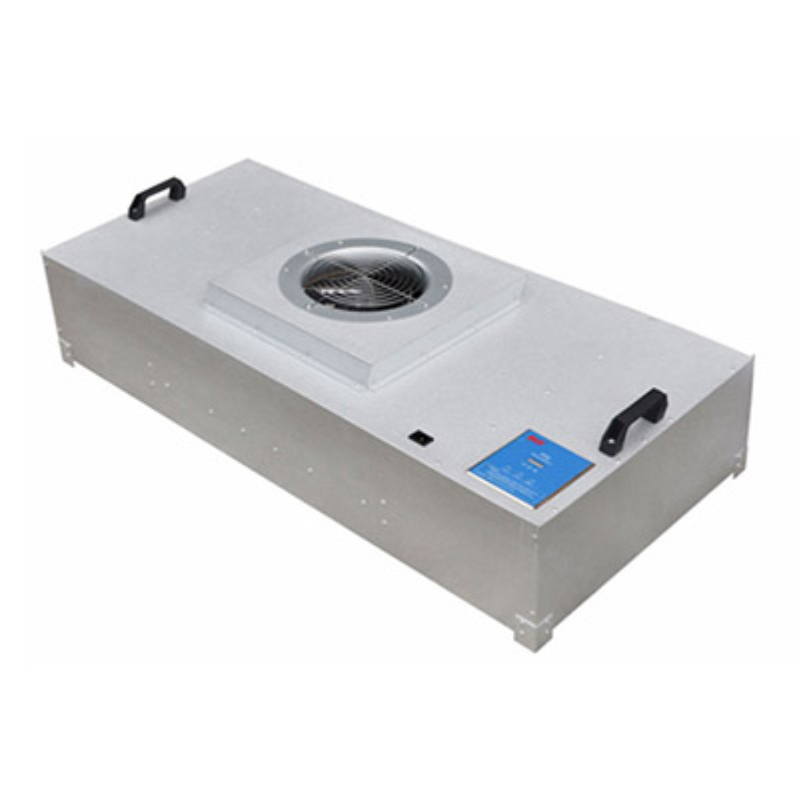
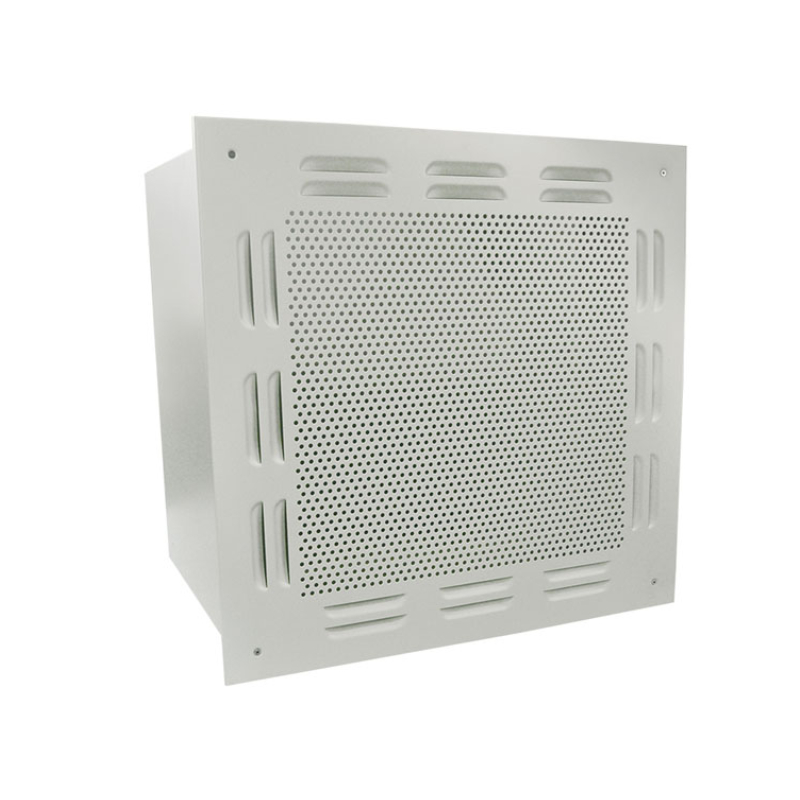
•Ports de test intégrés : terminal KLC boîtes de filtre HEPA et Unités de filtration pour ventilateurs (FFU) Elles sont équipées de ports d'injection de PAO et de ports d'échantillonnage en amont intégrés et accessibles. Cela permet aux techniciens d'introduire et de mesurer facilement les concentrations en amont directement depuis la pièce, sans avoir à accéder au plénum du plafond ni à percer les conduits de ventilation.
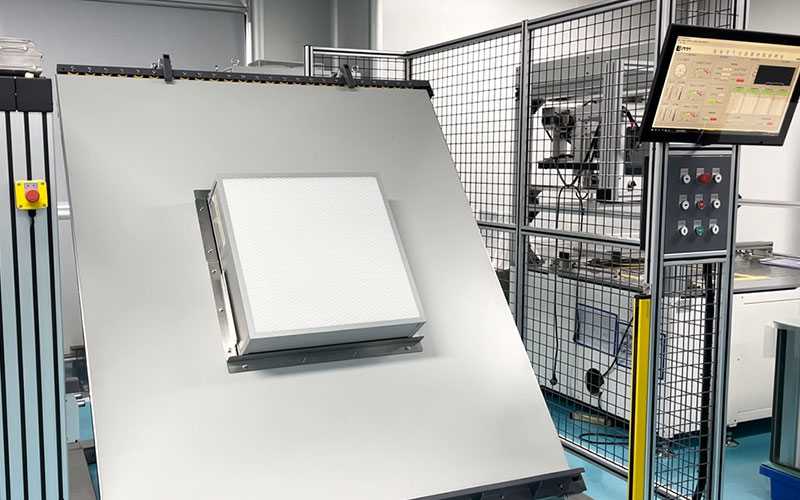
La classification des filtres HEPA (par exemple, EN 1822) est un test réalisé en laboratoire en usine qui mesure l'efficacité de filtration globale et locale absolue à la taille de particules la plus pénétrante (MPPS) du filtre, à l'aide de compteurs de particules spécialisés. En revanche, le test d'intégrité des filtres HEPA (par exemple, ISO 14644-3) est un test in situ, réalisé sur site, conçu pour détecter les fuites localisées, les défaillances de joints ou les dommages physiques (perforations) dans un système installé, à l'aide d'un générateur d'aérosol et d'un photomètre.
La vitesse de balayage est limitée car le photomètre d'aérosol nécessite un temps de réponse fini pour aspirer l'échantillon d'air en aval à travers le tube de la sonde, le traiter dans la chambre optique et calculer sa concentration. Si le technicien déplace la sonde à plus de 5 cm/s, une fuite minuscule peut se produire au niveau de l'entrée de la sonde avant que l'échantillon ne soit détecté par le capteur, entraînant des résultats faussement positifs et une contamination non maîtrisée de la salle blanche.
Oui, la norme ISO 14644-3 autorise l'utilisation de compteurs de particules discrets (CPD) pour les tests d'étanchéité des filtres HEPA, notamment dans les environnements ultra-propres (classe ISO 3 ou 4) où de fortes concentrations de gouttelettes d'huile PAO pourraient obstruer ou contaminer l'environnement. Cependant, les tests d'étanchéité basés sur les CPD sont plus lents, nécessitent des calculs complexes pour corréler le nombre de particules à la profondeur de pénétration et sont généralement plus coûteux que les tests basés sur un photomètre.
Si une fuite est détectée au niveau du joint d'étanchéité (à l'interface entre le cadre du filtre et la grille du boîtier), le technicien doit d'abord inspecter les colliers de serrage ou les vis de blocage. Si le joint est en néoprène sec, un serrage des colliers au couple spécifié par le fabricant peut suffire à colmater la fuite. Si le joint est endommagé, ou s'il s'agit d'un filtre à gel dont le gel est détérioré, le filtre doit être retiré, les surfaces d'étanchéité nettoyées et un nouveau filtre installé.
Une concentration inférieure à 10 µg/L ne génère pas suffisamment de particules d'aérosol en aval pour que le photomètre puisse mesurer avec précision un taux de pénétration de 0,01 %, ce qui réduit le rapport signal/bruit. À l'inverse, une concentration supérieure à 100 µg/L est inutilement dense, entraînant un encrassement rapide du filtre HEPA, une augmentation prématurée de la perte de charge et une accumulation potentielle de résidus d'huile dans les conduits.
Bien que le PAO soit sans danger pour l'homme, les gouttelettes d'huile peuvent se condenser sur les surfaces froides. Dans les usines de semi-conducteurs où les plaquettes de silicium brut sont exposées, tout film d'huile organique peut provoquer de graves défauts. C'est pourquoi les salles blanches de l'électronique privilégient souvent les méthodes de test d'étanchéité « à sec » utilisant des compteurs de particules à condensation (CPC) et des sphères de poussière atmosphérique ou de latex de polystyrène (PSL) propre, plutôt que le PAO à base d'huile.
Les filtres à joint gel utilisent un canal rempli d'un gel de polyuréthane non fluide qui enveloppe le périmètre du filtre et s'emboîte sur un rebord métallique du boîtier de la salle blanche. Lors de la validation, ces filtres présentent un taux de défaillance nettement inférieur à celui des filtres à joint en néoprène sec, car le gel, de consistance liquide, épouse parfaitement les irrégularités du boîtier, éliminant ainsi les problèmes de tension des colliers et les fuites.
Normalement, pour réaliser un test PAO, les techniciens doivent accéder au plénum du plafond afin d'injecter l'aérosol en amont et de prélever l'échantillon de référence en amont, une opération longue et risquée qui peut introduire des impuretés dans la salle blanche. Les ports intégrés du KLC permettent d'effectuer l'injection et le prélèvement en amont directement depuis la façade de la salle grâce à des buses à connexion rapide, réduisant ainsi le temps de test par filtre jusqu'à 50 % et préservant l'intégrité structurelle du plafond.
La validation des filtres HEPA est essentielle au maintien d'environnements stériles et exempts de particules. Se fier uniquement à l'inspection visuelle ou au simple comptage des particules est insuffisant pour identifier les fuites critiques, même minimes. Les responsables d'installations doivent mettre en œuvre un programme de validation rigoureux, semestriel ou annuel, des filtres HEPA, en utilisant des photomètres de haute précision et en faisant appel à des techniciens certifiés.
Pour faciliter la validation et garantir une étanchéité fiable, sélectionnez des systèmes de filtration terminaux équipés de ports de test intégrés et d'interfaces à joint en gel liquide.KLC Internationalpour parcourir notre catalogue complet de filtres haute efficacité H14 et U15, et découvrir comment nos solutions intégrées de boîtier FFU et HEPA simplifient la conformité réglementaire.



 Réseau IPv6 pris en charge